
GamesNFans logo GamesNFans

Esports vs Traditional Sports: Why Cricket Fans Should Care

Esports growth in India is reshaping fandom. Here is why cricket fans should watch competitive gaming, from skill parallels to the business of digital sport.
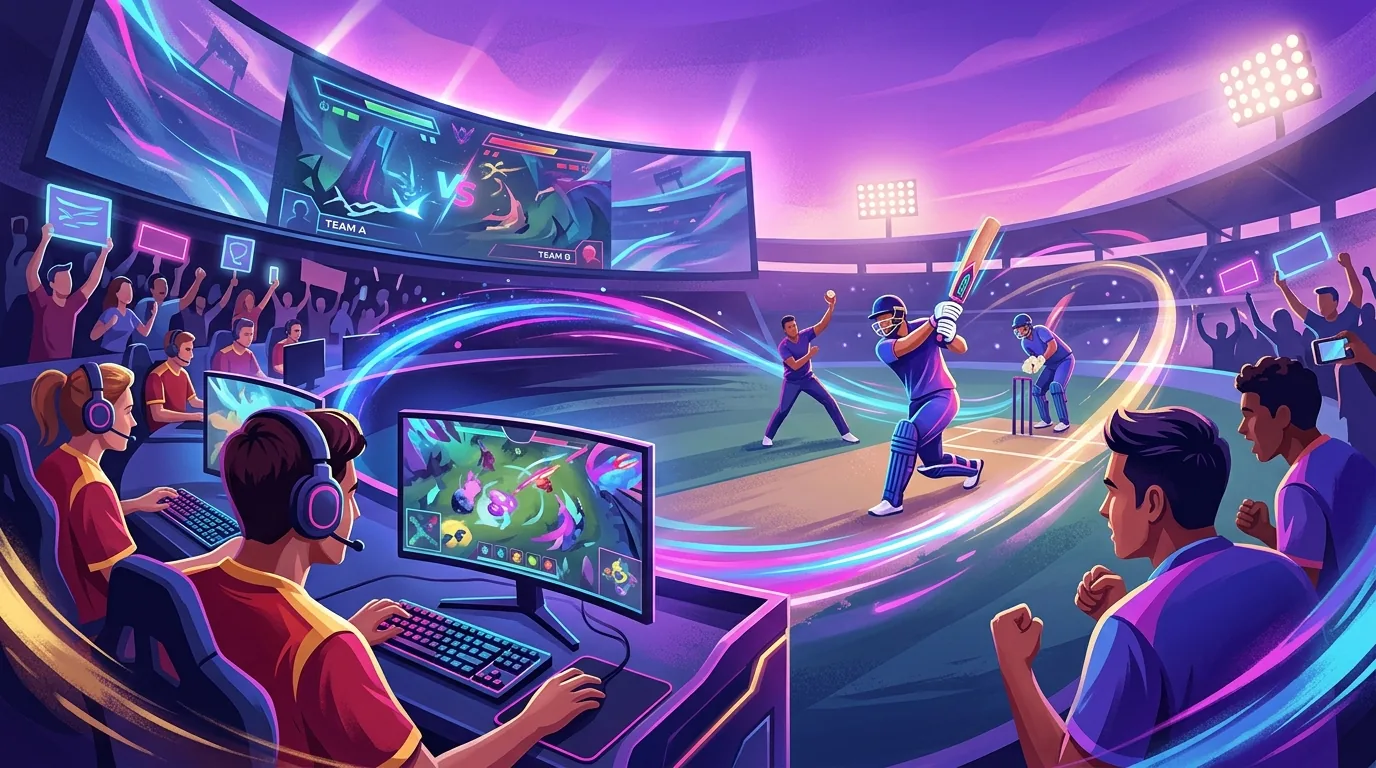
Esports vs Traditional Sports: Why Cricket Fans Should Care About the Rise of Competitive Gaming — illustrative featured image
The living room in Chennai goes quiet. Not the polite hush before a [cricket match](/blog/ind-w-vs-aus-women-3rd-t20i), but something sharper. Two teenagers are hunched over a laptop, fingers moving like they are playing a piano concerto at double speed. On screen, a Valorant agent peeks around a corner. A split second later, a headshot registers. The room erupts. The father, who had been skeptical for years, leans in and asks, "So, when is the next big tournament for this?" That scene is playing out in millions of homes across India right now. And it is the exact reason why the debate about esports vs traditional sports has moved from internet forums to living room conversations. For cricket fans who grew up idolizing Sachin or Dhoni, the rise of [competitive gaming](/blog/from-ipl-to-esports-how-indian-fans-are-changing-the-game) feels like a foreign invasion. But it is not. It is a parallel universe with the same gravitational laws, just different stars. ## The Money Talk: Where the Numbers Actually Stand Let us get the uncomfortable question out of the way. Is esports actually bigger than cricket? No. Is it growing faster? Yes, and it is not particularly close. The global esports market is projected to cross the $5 billion mark in the near future. Cricket, driven largely by the IPL broadcast deals and bilateral series rights, sits in a similar financial stratosphere, but the trajectory is what matters. Esports growth in India specifically has been nothing short of parabolic. The country now hosts multiple franchise leagues, and the audience for titles like BGMI and Valorant has exploded past the casual viewership of most domestic cricket tournaments that are not the IPL. Here is a quick comparison that puts things in perspective: | Metric | Traditional Sports (Cricket) | Esports | | --- | --- | --- | | Core audience age | 25 to 55 | 16 to 34 | | Viewing habit | Linear, scheduled matches | Live streams, VODs, clips | | Revenue model | Broadcasting rights, ticket sales | Sponsorships, digital goods, battle passes | | Global reach barrier | Requires physical stadiums, weather | Requires internet bandwidth only | The last row is the killer. Cricket needs a stadium, a ground, and a pitch. Esports needs a decent connection and a device. That is why a kid in a tier-3 city can compete with a kid in Seoul without leaving their room. The infrastructure cost of finding the next big esports star is a fraction of the cost of finding the next fast bowler. ## The Skill Ceiling: Why Fandom Transfers Here is where the cricket fan needs to pay attention. The skills that make a great esports athlete are eerily similar to those that make a great cricketer. Hand-eye coordination. Check. Reaction time measured in milliseconds. Check. Strategic shot-calling under pressure. Check. The ability to stay calm when the score is tied and the opponent is peaking. Check. The biggest misconception is that esports is "just reflexes." Anyone who has watched a professional Dota 2 draft phase knows it is a chess match played at 300 actions per minute. The macro strategy, the resource management, the psychological warfare of baiting an opponent into a bad fight. It is the same mental load a captain carries while setting a field for a death-over specialist. The [hidden challenges facing elite esports athletes](/blog/the-hidden-challenges-facing-elite-esports-athletes-what-science-says) go far beyond what spectators see on screen. ## The Business of Fandom: A Tale of Two Leagues The IPL is the gold standard for sports entertainment in India. It compressed a six-week festival into a television and streaming juggernaut. The esports ecosystem is trying to replicate that model, but it is doing so with a native digital DNA. The recent struggles of some Western esports organizations (the ones that promised to be bigger than the NBA) have made people cynical. And rightly so. There was a bubble. But the correction is not a death knell. It is a maturation. What the esports industry learned is that the "stick-and-ball" model of selling tickets and merch does not work when the game is free to play. Instead, the economy runs on cosmetics, battle passes, and direct-to-fan digital engagement. The revenue is not in the stadium seat, it is in the skin your avatar wears. For cricket, the comparison is stark. The BCCI sells broadcast rights for billions. An esports publisher like Riot or Valve sells a virtual skin for a few dollars. But they sell millions of them, every single day, all year round. The IPL has a two-month window. Esports has no off-season. ## The Indian Context: A Special Case The cricket [vs esports](/blog/720hz-gaming-monitor-for-esports-is-it-worth-buying-in-india) debate in India is unique because India is one of the few countries where both can coexist without cannibalizing each other. Cricket is a religion. Esports is a new sect. The IPL proved that India will adopt franchise models quickly. The rise of the Global Esports and Gods Reign rosters in international titles shows that Indian talent is not just participating, it is competing. Esports growth in India is being fueled by three specific drivers: 1. **Mobile penetration:** BGMI and Free Fire made esports accessible to the masses. You do not need a $2,000 PC. You need a phone that costs less than a cricket bat. 2. **Vernacular streaming:** Platforms like Loco and Rooter broadcast in regional languages, replicating what Star Sports did for cricket commentary. 3. **College culture:** University tournaments are becoming the new inter-school cricket circuit. The scouting ground has shifted from maidans to campuses. ## Why Cricket Fans Should Not Be Threatened There is a fear that esports will "steal" the youth away from cricket. This is a false binary. The same kid who watches a T20 final on Sunday will watch a Valorant tournament on Friday. The attention span is not zero-sum. In fact, cricket is learning from esports. The introduction of the Impact Player rule, the push for faster over rates, and the focus on data analytics are all attempts to make the traditional game more palatable to a generation raised on instant gratification. The IPL has adopted a "fan experience" model that is heavily borrowed from gaming conventions, complete with DJ sets and interactive AR filters. Similar cross-pollination is visible in how [Valorant Game Changers](/blog/valorant-game-changers-how-to-follow-and-support-women-s-esports-in-india) is building new fan communities in India. The two industries are not rivals. They are training partners. Esports athletes need the discipline of traditional athletes. Traditional sports leagues need the digital engagement strategies of esports. ## Our Take: Where the Smart Money and Attention Should Go If you are a cricket fan looking to dip your toes into the esports world, do not just watch a random stream. That is like watching a random Ranji Trophy match and wondering why it does not have the energy of an India vs Australia clash. You need context. Here is what we recommend: - **Start with the shooters:** Valorant or CS2. The rounds are short, the action is readable, and the clutch moments are easy to understand even if you have never played. Watch a match from the VCT Pacific league to see the aggression. For a deeper primer on what to expect, check out the [VCT to EWC insights on esports principles](/blog/from-vct-to-ewc-sideshow-s-insights-on-esports-principles-and-prodigies). - **For strategy buffs, skip Dota 2 initially.** It is overwhelming. Instead, watch a Mobile Legends or [League of Legends](/blog/drx-and-nuon-how-indonesia-korea-deals-are-shaping-esports-in-asia) Worlds match. The team fights are more visually digestible. - **Follow the Indian scene specifically.** Check out the Skyesports Championship or the [BGMI Masters series](/blog/how-to-watch-bgmi-masters-series-season-5-schedule-teams-and-streaming-on-kick). The production quality has improved massively, and the casting is bilingual, making it accessible. - **Do not buy the hype about "easy money."** The esports grind is brutal. Practice schedules are longer than most corporate jobs. The burnout rate is high. Respect the players for the athletes they are, not the streamers you see on YouTube. The future is not esports replacing cricket. It is a multi-sport identity where a fan can love the sweep shot and the AWP flick with equal passion. ## FAQ ### Is esports recognized as a sport in India? Yes, esports was officially recognized as part of the "multi-sports event" category by the Indian government in late 2022. It falls under the Ministry of Youth Affairs and Sports, which allows athletes to seek official recognition and funding. The distinction from "online gaming" (which involves real money wagering) is crucial, and esports is treated as a skill-based competition. ### How does the prize money in esports compare to cricket? The top tier of esports, like The International for Dota 2, has historically offered prize pools that dwarf most single cricket tournaments. However, the average professional esports player in India earns far less than a domestic cricket player. The money is top-heavy. Cricket offers better distribution across its player base, while esports offers massive jackpots at the very apex. ### Can a cricket fan enjoy esports without playing the games? Absolutely. The barrier to entry for watching is lower than you think. You do not need to know every ability to enjoy a well-executed flank or a clutch retake. Focus on the casters, they are trained to explain the "why" behind the action, much like a cricket commentator explains a field placement. Give it three matches to learn the rhythm, and the tension will hook you.

Frequently asked questions

Is esports recognized as a sport in India?

Yes, esports was officially recognized as part of the "multi-sports event" category by the Indian government in late 2022. It falls under the Ministry of Youth Affairs and Sports, which allows athletes to seek official recognition and funding. The distinction from "online gaming" (which involves real money wagering) is crucial, and esports is treated as a skill-based competition.

How does the prize money in esports compare to cricket?

The top tier of esports, like The International for Dota 2, has historically offered prize pools that dwarf most single cricket tournaments. However, the average professional esports player in India earns far less than a domestic cricket player. The money is top-heavy. Cricket offers better distribution across its player base, while esports offers massive jackpots at the very apex.

Can a cricket fan enjoy esports without playing the games?

Absolutely. The barrier to entry for watching is lower than you think. You do not need to know every ability to enjoy a well-executed flank or a clutch retake. Focus on the casters, they are trained to explain the "why" behind the action, much like a cricket commentator explains a field placement. Give it three matches to learn the rhythm, and the tension will hook you.