
GamesNFans logo GamesNFans

Esports Player Behavior: Why Soft Skills Win

Discover why esports team management must prioritize soft skills training. Learn actionable tips to fix toxic behavior and build a winning, stable roster.
Esports Player Behavior: Why Orgs Must Teach Soft Skills for Long-Term Success — illustrative featured image
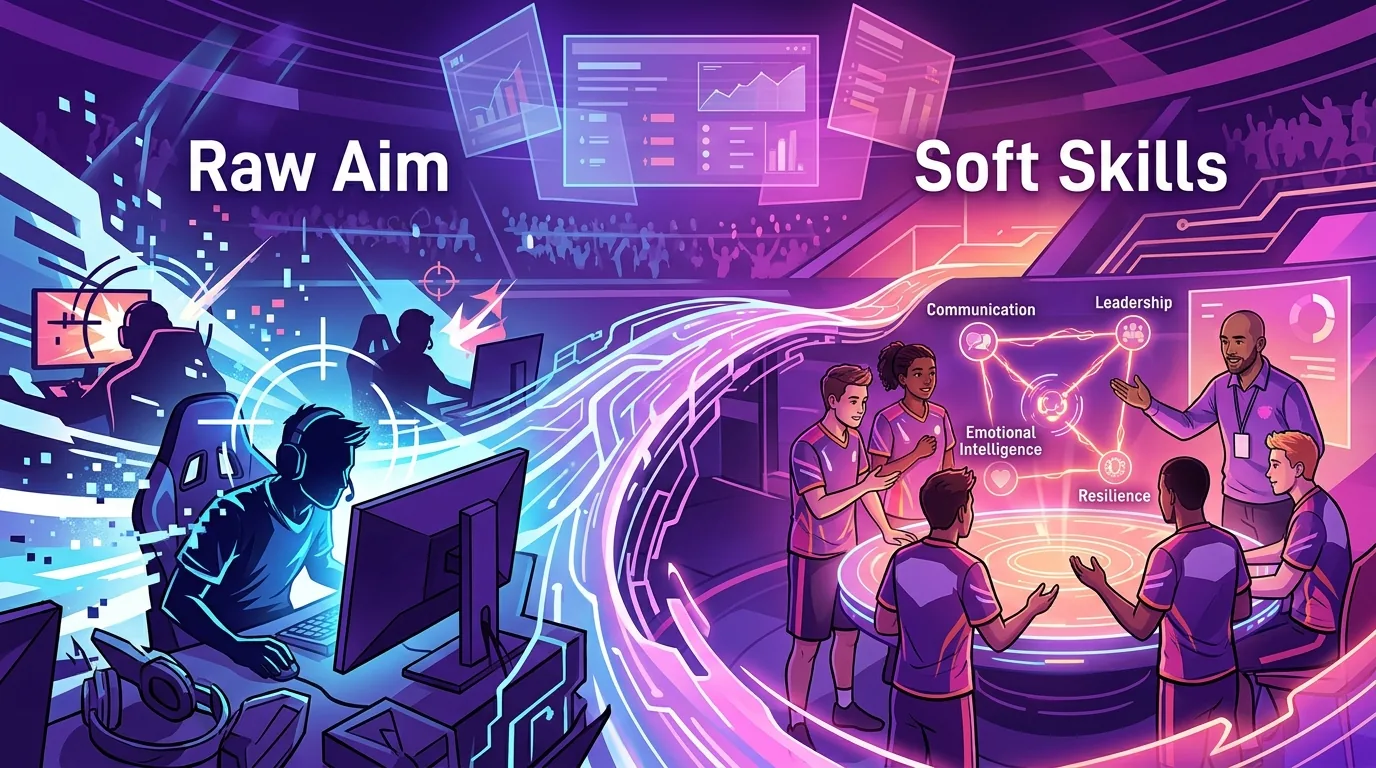
There is a specific, gut-wrenching sound a team makes when the comms go quiet at the worst possible moment. It happened during a lower-bracket final at a Major last year. The IGL called for a slow push on B, but the star entry fragger, a 19-year-old with lightning reflexes and a six-figure buyout, decided he wanted the highlight clip instead. He sprinted through mid, got traded, and then proceeded to blame the support player for not reading his mind. The round fell apart. The map fell apart. The series ended in a 2-0 stomp that looked less like a skill gap and more like a tantrum. We watched that collapse from the press booth and realized something crucial. That kid wasn't a bad person. He was a bad teammate. And nobody, not his coach, not his manager, not the sports psychologist they flew in for two days, had ever taught him how to say "my bad" without it sounding like an accusation. Here is the uncomfortable truth that esports team management often ignores: raw mechanical talent wins you the opening rounds, but emotional intelligence wins you the trophies. If you are running an organization and you aren't actively teaching soft skills in esports, you are literally burning money on roster salaries. [How to Build a Profitable Esports Organization Like T1: A Playbook](/blog/how-to-build-a-profitable-esports-organization-like-t1-a-playbook) shows how top-tier orgs structure their entire operation around sustainable success, not just flashy signings. ## The Mechanical Ceiling Let's get one thing straight. We love the mechanical gods. We love watching a player with 400 APM dance through a choke point or hit a flick shot that defies physics. That is the product. That is why we buy the jerseys. But the esports landscape has shifted. The gap between the top 0.1% of aimers and the top 1% is now microscopic. Everyone at the professional level has insane reflexes. Everyone has spent 10,000 hours in the practice tool. The differentiator, the thing that separates a perennial quarterfinalist from a dynasty, is how the roster functions as a unit under pressure. Poor esports player behavior is the silent killer of potential. It manifests in three visible ways: - **Passive-aggressive shot calling:** When a player stops communicating because they feel slighted by a previous round, the entire team plays blind. - **The blame spiral:** One mistake triggers a cascade of finger-pointing that lasts for two full rounds, effectively forfeiting the mental game. - **Refusal to adapt:** A star player who only wants to play their "style" and ignores the strategic adjustments called by the coach. We see these issues on stream constantly. The camera cuts to the booth, and you see a player physically recoil from a teammate's suggestion. You see the body language of a group of people who hate each other but are forced to share a space for the sake of a paycheck. That toxicity is not just unpleasant to watch; it is a competitive disadvantage. ## Why "Just Win" Fails Many old-school managers (usually ex-players who came up in the era of online qualifiers and no salaries) subscribe to the "winning fixes everything" school of thought. They believe that if the team is winning, the vibes will sort themselves out. This is dangerously naive. Winning masks dysfunction. It creates a false sense of security. A team can win a regional split while secretly harboring deep resentments, but the moment they face a team of equal skill in an international final, the cracks turn into canyons. The pressure of a LAN environment, the noise, the stakes, it amplifies every pre-existing flaw in communication. [Global Esports' Historic Reverse Sweep: What It Means for Indian Valorant](/blog/global-esports-historic-reverse-sweep-what-it-means-for-indian-valorant) is a perfect case study of how a roster that stays mentally locked in can overcome massive odds. Furthermore, consider the burnout rate. The average [esports career](/blog/from-bed-to-esports-star-a-parent-s-guide-to-supporting-your-gamer) lasts only five to seven years. When players leave the stage, they often have zero skills for the real world. They know how to draft a composition, but they don't know how to write an email. They know how to track ultimate timers, but they don't know how to handle a difficult conversation with a landlord. Orgs that ignore soft skills in esports are setting up their young talent for a brutal crash landing. There is also the financial reality of the trade market. When you try to sell a player to another org, you aren't just selling their K/D ratio. You are selling a personality. A player with a reputation for tilting and raging has a significantly lower market value, regardless of their mechanical ceiling. Conversely, a veteran leader who can stabilize a young roster commands a premium. Teaching behavior is an investment in asset value. ## The Blueprint for Better Behavior So, how do we fix this? We cannot just tell players to "be nice." That is not a training module. That is a platitude. Esports orgs need to treat behavioral coaching with the same seriousness as VOD review. Here is what we recommend implementing immediately. ### ### 1. Institutionalize the Debrief Stop ending scrims with a simple "gg go next." Instead, force a 15-minute structured debrief where the focus is on process, not outcome. - **Start with self-critique:** Each player must state one thing they did poorly before they are allowed to critique a teammate. - **Use "I" statements:** Ban the word "you" during the feedback phase. It is "I felt unsupported when I pushed B," not "You didn't follow me." - **The Coach as Mediator:** The coach must enforce this structure ruthlessly. If a player breaks protocol, they run laps or they sit out a drill. This forces accountability. It makes it safe to admit failure, which is the foundation of improvement. ### ### 2. Hire for Emotional Range, Not Just APM This is where scouting needs to change. We are not saying to ignore mechanical stats, but you need to weight personality tests and interview performance much higher in your evaluation matrix. During tryouts, do not just run 1v1s. Run a scrim where you intentionally put the prospective player on a losing team with a toxic teammate. Watch how they react. Do they match the toxicity? Do they go silent? Or do they try to uplift the team? That third option is your guy. That is the player you build a roster around. ### ### 3. Bring in Outside Experts No offense to the former pro coaches out there, but most of you are not trained psychologists. You are great at strategy, but you are not equipped to handle deep-seated anxiety or personality clashes. Bring in a professional. Not a "life coach" who talks about manifestation, but a licensed sports psychologist or a corporate team-building facilitator who works with high-stress environments. These professionals have tools that work. They run conflict resolution workshops. They teach breathing techniques for high-pressure situations. They give players a safe space to vent without fear of losing their starting spot. ## Our Take: The Non-Negotiables We have seen some orgs try to implement "wellness days" and call it a day. That is performative nonsense. We want to see real structure. Here is what we would mandate if we ran a franchise: - **Weekly One-on-Ones:** Mandatory 30-minute check-ins between the coach and every single player, every single week. No skipping. This is for catching small issues before they become blow-ups. - **Media Training for Everyone:** Even the quietest support player needs to know how to handle a hostile interview question. This builds confidence that translates into in-game leadership. - **Financial Literacy Seminars:** This sounds unrelated, but financial stress is a massive cause of anxiety and irritability. If a player isn't worried about their rent, they are less likely to snap at a teammate over a missed smoke. We also want to call out specific platforms that are helping. We have seen good results from organizations using **Mettl** for personality assessments during scouting, as it provides a data-driven baseline for behavioral traits. For actual coaching, we like the curriculum offered by **Prodigy Agency** and the mental performance modules from **Brave Mind**. These aren't ads; they are just the tools we have seen produce tangible results in reducing toxic incidents on stage. The bottom line is that esports player behavior is a management issue, not a player issue. If your team is toxic, look in the mirror. Look at your training schedule. Look at your hiring criteria. Are you rewarding good behavior or just good aim? The future of the industry depends on creating athletes who are as resilient mentally as they are mechanically. The orgs that figure this out will not just win more titles. They will build brands that sponsors love and fans respect. The orgs that don't will keep bleeding talent to burnout and drama, wondering why their million-dollar roster can't close out a series. Just look at how [Krafton's $250M India Bet: What It Means for BGMI Players and Esports Fans](/blog/krafton-s-250m-india-bet-what-it-means-for-bgmi-players-and-esports-fans) signals that major publishers are investing heavily in the long-term health of the scene. The game is changing. It is time the locker room caught up. ## FAQ **Q: Can soft skills really be taught to a 17-year-old who has been coddled by the system?** A: Yes, but it requires patience and consistency. You are not changing their personality; you are changing their habits. Through repetitive drills and enforced consequences (like benching for toxic behavior), you can rewire how they react to stress. It takes about 90 days of consistent reinforcement to see a noticeable shift, but it works. **Q: Are we expecting too much from teenagers who are thrust into a professional environment?** A: Perhaps, but that is the reality of the industry. If they are old enough to sign a contract and take a salary, they are old enough to learn professional decorum. The burden is on the org to provide the education. You cannot expect a teenager to know how to handle the pressure of a live audience if you never teach them. **Q: What is the first sign that an org is failing at this?** A: High roster turnover. If you are constantly swapping players in and out every split, you are treating the symptom (poor performance) and not the disease (poor culture). A stable roster that grows together over two years will almost always outperform a "superteam" of mercenaries who have never learned to trust each other.

Frequently asked questions

Q: Can soft skills really be taught to a 17-year-old who has been coddled by the system?

A: Yes, but it requires patience and consistency. You are not changing their personality; you are changing their habits. Through repetitive drills and enforced consequences (like benching for toxic behavior), you can rewire how they react to stress. It takes about 90 days of consistent reinforcement to see a noticeable shift, but it works.

Q: Are we expecting too much from teenagers who are thrust into a professional environment?

A: Perhaps, but that is the reality of the industry. If they are old enough to sign a contract and take a salary, they are old enough to learn professional decorum. The burden is on the org to provide the education. You cannot expect a teenager to know how to handle the pressure of a live audience if you never teach them.

Q: What is the first sign that an org is failing at this?

A: High roster turnover. If you are constantly swapping players in and out every split, you are treating the symptom (poor performance) and not the disease (poor culture). A stable roster that grows together over two years will almost always outperform a "superteam" of mercenaries who have never learned to trust each other.

### 1. Institutionalize the Debrief Stop ending scrims with a simple "gg go next." Instead, force a 15-minute structured debrief where the focus is on process, not outcome. - **Start with self-criti

The future of the industry depends on creating athletes who are as resilient mentally as they are mechanically. The orgs that figure this out will not just win more titles. They will build brands that sponsors love and fans respect. The orgs that don't will keep bleeding talent to burnout and drama, wondering why their million-dollar roster can't close out a series. Just look at how [Krafton's $250M India Bet: What It Means for BGMI Players and Esports Fans](/blog/krafton-s-250m-india-bet-what-i