
GamesNFans logo GamesNFans

Esports Injuries: Prevention and Treatment for Gamers

Learn how to prevent and treat common esports injuries like carpal tunnel and tendinopathy. Discover ergonomic tips and gear to protect your gamer health.
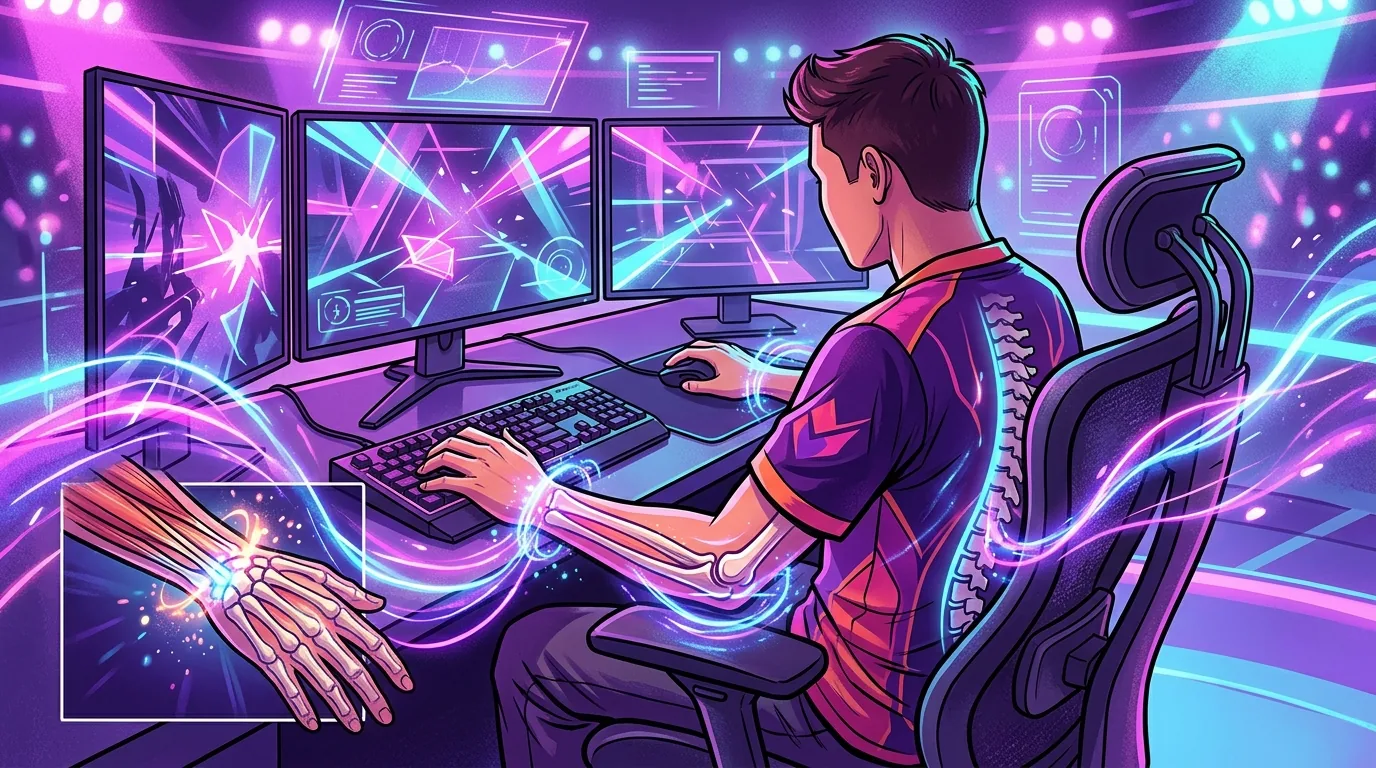
Esports Injuries: How to Prevent and Treat Common Gamer Ailments — illustrative featured image
The crowd noise in a packed arena is deafening, but for the players on stage, the only sound that matters is the low hum of their own [mechanical keyboards](/blog/best-gaming-keyboards-2026-optical-vs-mechanical-a-buyer-s-guide). The camera pans to a star mid-laner mid-teamfight, fingers dancing across the keys with mechanical precision. Then, the game pauses. He shakes his right hand, wincing. The casters notice, the chat notices, and within seconds, a million viewers are speculating about his wrist. We love to talk about the mental fortitude of esports pros, the hours of VOD review, the clutch-factor gene. But the gritty, unglamorous reality is that a 22-year-old kid can lose his career to the same repetitive strain injury that plagues a 50-year-old accountant. Professional gaming is brutal on the body, and the growing field of sports medicine is finally starting to treat it with the seriousness it deserves. If you are grinding ranked queues for six hours a day, or just cramming a weekend of tournaments, your tendons are the real endgame boss. Here is how to survive the fight. ## The Anatomy of a Gamer’s Breakdown We tend to think of esports injuries as "just wrist pain," but that is like calling a broken leg "just a walking problem." The issues are systemic, stemming from hours of low-intensity, high-repetition motion in static, often terrible, postures. The most common culprits are: - **Carpal Tunnel Syndrome:** Compression of the median nerve in the wrist. You feel it as numbness, tingling, or a dull ache in the thumb and first two fingers. It is the classic "mouse hand" ailment. - **De Quervain’s Tenosynovitis:** Inflammation of the tendons on the thumb side of the wrist. This one is brutal for players who favor claw grips or use heavy thumb movement for spacebars and thumbsticks. - **Cubital Tunnel Syndrome:** The "funny bone" nerve gets compressed at the elbow. If your armrest is digging into your ulnar nerve, you will feel shooting pains down your forearm and into your ring and pinky fingers. This is a keyboard player’s curse. - **Tendinopathy:** General wear and tear on the tendons, often in the forearm extensors. This feels like a deep, burning soreness that doesn't go away with a quick stretch. - **Cervical Radiculopathy:** The neck and upper back. A forward head posture (the infamous "gamer neck") puts massive pressure on the cervical spine, which can refer pain all the way down into the hands. We saw a wave of high-profile retirements and benchings in recent years because of these exact issues. It is not a joke, and it is not a sign of weakness. It is a biomechanical failure caused by ignoring the body for the sake of the game. ## Prevention: The Unsexy Grind The good news is that most of these injuries are preventable. The bad news is that the prevention routine is boring, and it takes time away from aim training. ### Fix Your Setup (The Ergonomic Trinity) You can buy all the gamer gear in the world, but if your desk is a coffee table and your chair is a dining room chair, you are cooked. Proper [ergonomic gaming](/blog/esports-injuries-how-pro-gamers-stay-healthy-and-what-you-can-learn) isn't about buying a $500 chair; it is about geometry. 1. **The 90-Degree Rule:** Your elbows should be at a 90-degree angle, with your forearms resting comfortably on the desk or armrests. Your knees should also be at a 90-degree angle, with your feet flat on the floor. 2. **Eye Level:** The top of your monitor should be at or slightly below eye level. You should not be looking down at your screen like you are reading a book on the toilet. 3. **The Float Test:** When you place your hands on the keyboard and mouse, your shoulders should be relaxed, not hunched up toward your ears. If they are, your desk is too high. ### The Micro-Break (The 20/20/20 Rule) Your eyes need a break, but your tendons need it more. Every 20 minutes, look at something 20 feet away for 20 seconds. This gives your eye muscles a rest, but more importantly, it forces you to drop your hands from the peripherals. Use that time to shake out your arms like wet noodles. It looks silly. It works. ## Treatment: When the Damage is Done So, you ignored the warning signs. Your wrist is buzzing, your elbow is clicking, and you are starting to lose grip strength mid-game. Do not panic. Panic makes you grip harder, which makes it worse. ### The Immediate Response (The 48-Hour Window) If you feel a sharp pain or a sudden "pop," stop playing. Immediately. Ice the area for 15 minutes at a time, several times a day. Over-the-counter anti-inflammatories (like ibuprofen) can help, but they mask the pain, so do not use them as a ticket to keep playing. If you have numbness or tingling that lasts more than a couple of days, see a doctor. Not a chiropractor. A medical doctor, preferably one who knows sports medicine. ### The Rehab Phase Once the acute pain subsides, you need to rebuild strength. This is where a lot of players fail. They stop playing for a week, the pain goes away, and they jump straight back into a 10-hour session. That is how you get a chronic injury. You need to do specific exercises to strengthen the forearms and the intrinsic muscles of the hand. Simple resistance band exercises for finger extension and wrist flexion are the gold standard. You can also use a "grip trainer" (like the ones powerlifters use) but be careful not to overdo it. ### When to Seek a Specialist If you have been dealing with pain for more than three weeks, you need a professional. Look for a physical therapist who specializes in upper extremity conditions. They can do dry needling, ultrasound, or specific manual therapy that a general practitioner cannot offer. They can also tape your wrist or elbow in a way that offloads the pressure, allowing you to play at a lower intensity while you heal. ## What We Recommend: Our Take on Gear and Gadgets We are not doctors, and we do not play one on Twitch. But we have tested a lot of gear, and we have strong opinions on what is worth your money for gamer health. - **The Mouse:** We are big fans of **Logitech’s G Pro X Superlight**. It is absurdly light (under 63 grams), which means you use less force to move it, reducing strain on your shoulder and wrist. If you have a death grip, look for a mouse with a lower profile, like the **Razer DeathAdder V3**, which forces a more relaxed palm grip. - **The Keyboard:** Stop using those super-tall mechanical switches if you have finger pain. Look for **low-profile switches** (like the ones in the **Logitech G915** or **NuPhy Air75**). They require less travel distance, meaning less tendon excursion for every keystroke. Your APM will drop by 2%, but your tendon health will rise by 50%. - **The Wrist Rest:** We hate gel wrist rests. They feel great for five minutes, but they compress the carpal tunnel. We recommend a **hard, low-profile rest** made of resin or wood that only supports your palm, not your wrist. The **Glorious Gaming Wrist Rest** is a solid, affordable choice. - **The Standing Desk:** This is the big-ticket item. If you can swing it, a standing desk (like the **Uplift V2** or **Fully Jarvis**) is the single best investment for your spine. Alternate between sitting and standing every 45 minutes. It changes the load on your neck and lower back dramatically. ## The Mental Side of the Physical Pain There is a stigma in esports that playing through pain is "tough." It is not. It is stupid. It ruins careers. We have seen players who were top 10 in the world fall to irrelevance because they refused to take two weeks off to let a wrist strain heal. They took six months off instead, and they never got their speed back. If you are a competitive player, you have to treat your body like a high-performance engine. You would not run a Formula 1 car on flat tires. Do not play a Grand Final with a strained flexor tendon. ## FAQ **Q: How long should I rest if I feel wrist pain from gaming?** A: If it is mild soreness, take 48 hours off. If it is sharp pain or numbness, stop immediately and consult a doctor. Do not "play through it" for even one match. The rule of thumb is: if it hurts to touch, you are done for the day. **Q: Are ergonomic keyboards actually worth it for gamers?** A: Split keyboards (like the **Kinesis Advantage360** or the **ZSA Moonlander**) are fantastic for keeping your wrists in a neutral position, but they have a steep learning curve. If you are serious about a career in esports, they are worth the month of misery it takes to relearn typing. If you are a casual player, a standard low-profile board is fine. **Q: Can I use a controller instead of a mouse and keyboard to avoid injuries?** A: Not really. Controllers cause their own set of issues, specifically "PlayStation thumb" (tendinitis in the thumb joint) and trigger finger. The best advice is to switch up your input methods if possible, but the core issue is repetitive motion. You need rest and strength, regardless of the controller. ## Related on this site - [The Hidden Toll of Pro Gaming: Injury Prevention Tips for Indian Esports Athletes](/blog/the-hidden-toll-of-pro-gaming-injury-prevention-tips-for-indian-esports-athletes) - [720Hz Gaming Monitor for Esports: Is It Worth Buying in India?](/blog/720hz-gaming-monitor-for-esports-is-it-worth-buying-in-india) - [From Bed to Esports Star: A Parent's Guide to Supporting Your Gamer](/blog/from-bed-to-esports-star-a-parent-s-guide-to-supporting-your-gamer)

Frequently asked questions

Q: How long should I rest if I feel wrist pain from gaming?

A: If it is mild soreness, take 48 hours off. If it is sharp pain or numbness, stop immediately and consult a doctor. Do not "play through it" for even one match. The rule of thumb is: if it hurts to touch, you are done for the day.

Q: Are ergonomic keyboards actually worth it for gamers?

A: Split keyboards (like the **Kinesis Advantage360** or the **ZSA Moonlander**) are fantastic for keeping your wrists in a neutral position, but they have a steep learning curve. If you are serious about a career in esports, they are worth the month of misery it takes to relearn typing. If you are a casual player, a standard low-profile board is fine.

Q: Can I use a controller instead of a mouse and keyboard to avoid injuries?

A: Not really. Controllers cause their own set of issues, specifically "PlayStation thumb" (tendinitis in the thumb joint) and trigger finger. The best advice is to switch up your input methods if possible, but the core issue is repetitive motion. You need rest and strength, regardless of the controller.